This series contains short histories, minutes, first house meetings, and the quarterly and financial reports of Theophany, an experimental community group of the Congregation of the Sisters of St. Joseph of London, Ontario, from 1972 to 1983. Various Sisters who were members of Theophany lived first at a house on Grosvenor Street then at Wellington Street in London. They sought personal growth through a communal life of daily group praying and by the spontaneous sharing of their prayer experience. There is a list of Sisters who were stationed at the Theophany Community House from 1972 to 1983 and priests who celebrated Mass for the Sisters at the house from 1972 to 1974. There is correspondence from Mother Mary Brendan, Superior General. One letter is to Sister Loretta Janisse related to her appointment as the Co-Ordinator of the Theophany Community, from 1974 to 1975, and other letters encourage the Theophany Sisters to have co-responsibility and accountability to each other, and to the Community. In addition, there is a printed picture given by Sister Elaine (Marie Noel) Cole in 2020. The printed picture is a photograph of the first group of Sisters who resided at the Theophany Community House that was taken on September 23, 2006, at a social gathering in anticipation of the closing of the Mount St. Joseph Motherhouse in London. In addition, there is a scrapbook that contains photographs with slogans and text cut-out from magazines. Photographs in the scrapbook depict Sisters, priests, and guests at the Theophany Community Houses at Grosvenor Street and at Wellington Street.
Sans titreThis series contains qualitative and quantitative statistical data collected by the Congregation of the Sisters of St. Joseph of London, Ontario on their activities from 1858 to 2009. The statistics are presented in surveys, lists, quantitative summaries, and a timeline as well as related correspondence. Some of the information was collected to be reported to external parties or based on events, such as Sisters’ jubilees, as well as the use of lay and religious names after Vatican II. Major topics of the data include demographics, leadership, deaths, and occupations within the community and the Sisters’ various ministries. The Sisters’ ministries include administration of motherhouses, care of orphans and the elderly, education, healthcare, retreat centers, marriage tribunals, parish and pastoral work, and works of mercy. Works of mercy summarizes various charitable activities, such as a foster home for the severely disabled, a refugee house, various recovery and rehabilitation homes, youth ministry, and ministry to Indigenous communities. Major locations for the Sisters’ activities include Ontario, Alberta, and the Northwest Territories, though the material is primarily focused on Ontario and Alberta.
Some of the statistics prepared for external parties were reported to the diocese of London and published in the Ontario Catholic Year Book and Directory, and to the Sisters of St. Joseph of the French Federation for the 350th anniversary of the Foundation in Le Puy. Other statistics were collected in reports and questionnaires for various offices of the Holy See to be used in the creation of the Annuario Pontificio, the Holy See’s annual directory, and the Statistical Yearbook of the Church. Accompanying these statistics is correspondence and a guide outlining the duties and powers of congregational leadership and the canons which govern the constitution of the Sisters of St. Joseph of London, Ontario. There are also reports and correspondence concerning the canonical visits of the Bishop of the diocese of London, and about Sisters being appointed Treasurers at various institutions operated by the congregation.
Sans titreThis series contains a short historical summary of the western mission in Killam, Alberta in the Archdiocese of Edmonton by the Congregation of the Sisters of St. Joseph of London, Ontario. The Sisters established and operated Our Lady of Fatima Separate School in Killam from 1952 to 1992. The historical summary covers a date range from 1954 to 1976. Starting in 1976, the staff at the Our Lady of Fatima School consisted of lay personnel. In this historical summary, there are topics on the founding of the school, building construction, official opening and renaming of the school, renovations, addition of extra classrooms including a science laboratory, increase of student enrollment, expansion and growth from an elementary to junior to a senior high school, scholastic exams, bus transportation, school trips, parent-teacher days, and the retirement and hiring of teachers. In addition, there is a photograph of a “Annual Hall of Fame Awards 1990” plaque from the Killam Chamber of Commerce which was given to Sisters Lourdes Thomas, Mary Kevin Moran, and Rose Ellen Donnelly.
Sans titreThis sous-contains fundraising documents pertaining to rural collections and the Orphans’ Festival which show that the Sisters needed support from the surrounding community in order to operate the orphanage. Articles, tickets, programmes, and receipts from the annual Orphans’ Festival show the importance the event held, not only to the Sisters but also to Hamilton citizens. Financial records further illustrate how much money was needed to care for the orphaned children. The account books detail the necessary items Sisters purchased to successfully run the orphanage. The fee books show how much parents paid to foster their children. These records also demonstrate the needs the Sisters had on outside resources, like government grants and surrounding community funding. Documents pertaining to regulatory compliance are also found, including the 1965 Children’s Institutions Act and Regulations which outlines the rules the orphanage had to follow in order to operate within the law. Correspondence on a variety of topics is also present in the collection, including finance, education, and daily operations. There are photographs which offer a “snapshot” into the life of the orphanage. These images depict Sisters working in the orphanage, the Orphans’ Festival, children’s communion celebrations, and the dining hall. The sous-fonds also contains records created by the Advisory Committee of Mount St. Joseph Orphanage. These records outline the types of work the committee did, including structural changes to the building. There are several summaries of the history of St. Mary’s Orphanage, and a brief summary of the history of Mount St. Carmel Infants’ Home. The registers offer significant information about the children who remained in the care of the orphanage. These list information such as the orphan’s name, date of birth, religious denomination, nationality, date of admission and discharge, date of death [if applicable], and who took the child after he or she was discharged. There are also registers that list information about children who stayed for day stays, as well as children who were moved into foster homes. The sous-fonds contains information about orphans who received their religious sacraments, as well as baptismal records. Also found personal folders and admission cards, which provide information about application and departure, correspondence and parental addresses and occupations.
Sans titreThis fonds contains Christian catechism books used by John McKeown. As a child, John McKeown received catechism lessons from the Sisters of St. Joseph of Hamilton, Ontario in Markdale, Ontario. Christian catechism is the religious teaching of children (or adult converts) in the foundational beliefs of the faith. The lesson text, work sheets (marked by a Sister), and colouring pages are included. Some of the lesson text was created by John Joseph Glennon, Archbishop of St. Louis, USA; George Cardinal Mundelein, Archbishop of Chicago, USA; and the Sisters of Service in Regina, Saskatchewan.
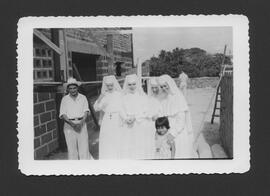
Sans titreThis series contains records created and accumulated by the Sisters of St. Joseph of Pembroke, Ontario during their mission in Peru which was focused on providing education and healthcare. There are also records from activities after the mission officially concluded, such as anniversary celebrations, lay volunteers traveling to Chincha Alta, and the activities of the Peruvian Sisters and Associates. Some records include information on natural disasters and political and social events in Peru during the Sisters’ mission. There are also records related to the charitable and religious organizations the Sisters collaborated with while in Peru and the establishment, activities, and future planning of the Peruvian Sisters of St. Joseph and Associates. Associates are lay people who participate in the Sisters charism but do not take religious vows. There are historical summaries, reports, personal accounts, correspondence, blueprints, architectural drawings, a map, contracts, financial records, mission evaluations, meeting minutes, news clippings, newsletters, publications, pamphlets, event programs, booklets, video recordings, statistics, and photographs.
Sans titreThe sous-fonds contains policy manuals, newspaper clippings, intake procedures, photographs, scrapbooks, correspondence, meeting minutes, financial records, as well as the record book and cash book of the Fontbonne Auxiliary. It also contains information about the history of the building, the children who were at Fontbonne Hall and the people who were involved in their care. There is also information about how the purpose of Fontbonne Hall changed throughout its time in operation.
Sans titreSeries contains of bulletins, newsletters, and newspaper clippings discussing the School of Christ program. It also contains a variety of photographs depicting its participants and organizers. There is one audio cassette of Sister Mary Margaret Childs, director of the senior choir, talking about her memories of the program, and one vinyl plaque presented to Sisters Mary Margaret Childs and Maureen Dalton from a group of alumni.
Sans titreFonds consists of histories written about the hospital, a newspaper, newspaper clippings, correspondence, a memorandum of agreement, financial papers, a staff list, an invitation, and a newsletter.
Sans titreThe fonds consists of histories for Killam, Galahad, Rimbey and Stettler hospitals that have been combined to create a history of the Alberta hospitals run by the Sisters of St. Joseph. Killam General Hospital was opened for the longest period of all these hospitals, and therefore a large quantity of the combined history is about this hospital. Along with the series for the histories of the four hospitals, there are series for commemorative and administrative materials. The fonds contains community histories, a timeline, staff listings, correspondence, newsletters, pamphlets, and photographs.
Sans titre